How it actually works
The email sequence nobody talks about: post-purchase
Most email marketing content is about acquisition. The post-purchase flow is where the actual money lives, and almost nobody writes about it. Here's what to send, when, and why it matters more than your welcome series.
If you read marketing content about email, you’d think the entire job was the welcome sequence. There are a thousand posts about welcome flows. There are conferences about welcome flows. There are agencies that will charge you several thousand pounds to write you a welcome flow.
What there are almost no posts about: the emails you send after someone’s bought. Which is strange, because the post-purchase sequence is where the actual money is. It’s where repeat purchases come from. It’s where reviews come from. It’s where the “I love this brand” feeling either gets built or doesn’t. And it’s the cheapest, highest-leverage email work you can do, because the audience is people who already gave you money.
I’ve built post-purchase flows for half a dozen businesses — mostly DTC ecommerce, one B2B SaaS — and I want to walk through what’s actually in them, in the order I send them, and why each one is there. None of this is theoretical. These are the emails I would send tomorrow.
The trap of over-thinking the welcome sequence
Quick aside on welcomes. They matter. They are also overbuilt by every brand on the internet. A welcome series should be three emails — sometimes two — and it should not pretend to be a brand documentary. The more emails you put between “they signed up” and “they bought,” the more chances you give them to lose interest. Welcome flows are a trim, not a haircut.
Anyway. Post-purchase. That’s the piece.
What “post-purchase” actually covers
A post-purchase email is any automated email triggered by an order. The transactional ones — order confirmation, shipping notification, delivery — are part of the sequence whether you treat them that way or not. The marketing ones — review requests, replenishment reminders, product education, cross-sells — are the ones brands either build properly or skip.
Here’s the thing nobody tells you: the transactional emails are the ones with the highest open rates of any email you will ever send. Order confirmations get opened 60–80% of the time. Shipping emails get opened 50–70% of the time. Compare that to your weekly newsletter at 22% on a good week. That gap is the opportunity. The transactional emails are the most-read emails you have, and most brands send them as if they were filing a tax form.
The sequence I actually build
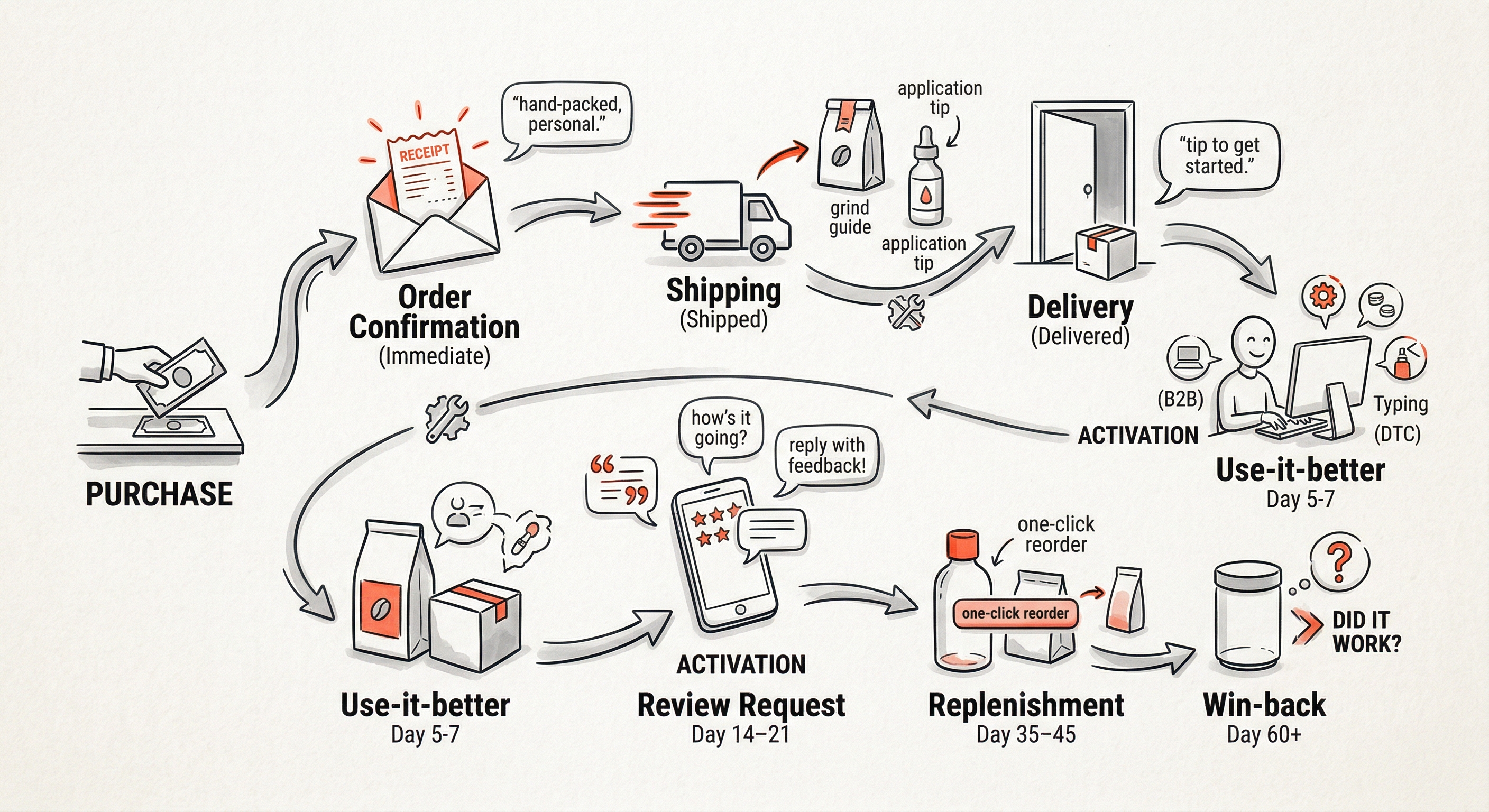
For a typical DTC ecommerce client — let’s say a £40-£80 product with a 6–8 week repurchase window — I build something like this:
Email 0: Order confirmation (immediate)
The most-opened email of the relationship. Most brands waste it. They send a templated receipt and call it done.
What I put in it: the receipt, yes, because that’s what the buyer wants. But also a single short paragraph in the brand voice — usually something honest and a little surprising. “We hand-pack these on Wednesdays, so if you ordered today you’re going in the next batch. You’ll get a shipping email the moment we hand it to the courier.” That’s it. No upsell. No discount code. Just one sentence that makes the buyer feel like they bought from a real human.
You can tell the buyer feels it because the reply rate to a humanised confirmation is way higher than a templated one. People reply with thank-yous, with corrections to their address, with questions about the product. Treat those replies like gold.
Email 1: Shipping notification (when shipped)
Another transactional email with a huge open rate. Most brands send it from a no-reply address with a courier link and nothing else.
What I add: the courier link, obviously. And then, in the same email, a single piece of education about the product that the buyer is about to receive. For a skincare brand: “Here’s the one thing to do the first time you use this.” For a coffee subscription: “Here’s the grind size we recommend if you’ve got an espresso machine.” For a B2B tool: “Here’s the first thing to set up when you log in tomorrow.”
This is the cheapest customer-success move in marketing. The buyer is excited. They are about to use the thing. They are paying attention. Tell them the one thing that will make their first experience better. They will remember it.
Email 2: Delivery confirmation (when delivered)
If the courier reports the package as delivered, fire an email about an hour later. (One hour, not immediately — let them open the box first.)
The email is short. “Your order is delivered. Quick thing: if you’re new to [product], the trick is [one specific tip].” If you have a getting-started page, link to it here, not in the receipt or shipping email. This is the moment the buyer is most likely to actually click it.
For ecommerce, this is also the moment to set expectations on when to ask for a review. A line like “We’ll check in with you in two weeks to see how you’re getting on — no rush.” That sentence makes the review request later feel like it’s expected, not pushy.
Email 3: Education / use-it-better (day 5–7)
Five days after delivery — long enough that they’ve used the product, short enough that they haven’t forgotten. This is the email where you double down on getting the buyer to actually use the thing they bought.
For DTC: a “here’s how to get the most out of [product]” email. Not features. Use cases. “Three ways our customers use [product] that aren’t obvious.” For B2B: a “here are the three things to set up in your first week” email. Pick the three things that strongly correlate with retention — most B2B tools have a few activation actions that, if a user does them in the first week, strongly predict they’ll still be using the tool in a month. Tell them to do those things. Don’t make them figure it out.
This is the email where churn risk gets cut in half if it’s good and stays the same if you skip it.
Email 4: Review request (day 14–21)
The classic. Most brands send this as a “would you leave us a review?” email with a star widget. It works, sort of, and you can do better.
The version I write asks for a specific thing. Instead of “leave us a review,” it says: “Two questions: how’s it going, and is there anything we got wrong? If you’ve got 30 seconds, you can leave a review here. If you’ve got a minute and want to tell us something more useful, just hit reply.” Then you give them both options.
The review numbers from a “specific question” email are roughly the same as a generic one. The reply rate is much higher, and the replies are where you find out what’s actually working and what isn’t. Some of those replies become the testimonials you put on the homepage. Some become the bug reports that fix the product. Both are worth more than a five-star widget.
Email 5: Replenishment / re-engagement (day 35–45 for consumables)
For consumable products, there’s a sweet spot a week or two before the customer is likely to run out. For a 6-week-supply skincare product, that’s day 35–40. For a 4-week coffee subscription, it’s day 22–25. For a B2B SaaS, it’s the renewal nudge.
The email is short and useful. “Most people on this product reorder around now. Here’s a one-click reorder if you’re ready, and here’s a slightly different version if you want to try it.” Notice the optionality. A reorder email that only links to the same product feels pushy. One that offers two options — same thing, or this slightly different thing — feels like a recommendation.
Replenishment emails are the highest-revenue emails in most ecommerce stacks. They are also the ones that most brands either skip or send badly.
Email 6: Win-back (day 60+ if no repurchase)
If the buyer hasn’t repurchased by the time the product should reasonably be gone, you’ve got two choices. Send a “we miss you” email with a discount, which works fine and trains the buyer to wait for discounts. Or send a “did this work for you?” email with no discount, which converts at maybe 70% of the discount version but doesn’t train the discount habit.
I default to the “did this work for you?” version. It’s a soft email that asks an honest question and offers help. The reply rate is high, and a meaningful percentage of replies are “I loved it, I just got busy” — at which point you reply personally with a one-click reorder link and you’ve recovered a customer without burning margin.
Most “we miss you” sequences don’t actually want to know the answer. The good ones do, because the answer is where the next product is hiding.
What this stack does to the numbers
The boring honest truth about email is that almost any business that builds out a real post-purchase sequence — even just emails 0 through 4 — sees email revenue grow by 15–35% over the following quarter. Not because the emails are magic. Because most brands were leaving these emails on the floor. The lift comes from doing the thing, not from doing it cleverly.
For one of the businesses I worked with, building out the full sequence in Klaviyo (which is overpriced and which I still default to because its flow builder is the best in the category) added about 18% to total email revenue in the first 90 days. For context: that was a six-figure DTC list — about 80,000 active subscribers, around £45,000/month in attributed email revenue going in — so 18% was meaningful in absolute terms. A list a tenth that size will see roughly the same percentage lift but a very different number on the invoice. None of those emails sold anything new. They sold the thing the customer already wanted and almost-bought.
What to do if you only have time for one thing
Build email 1 (the shipping email with one piece of product education) first. It’s the highest-leverage post-purchase email in any business. It runs on existing transactional infrastructure, it has a 60%+ open rate, and it directly improves the first experience of the product. If you build nothing else, build that one.
Then build email 5 (the replenishment / renewal one), because that’s where the revenue is. Then everything else, in any order.
If you want a related piece in a different shape, I reverse-engineered how 10 SaaS companies do content marketing is another piece about an unsexy part of marketing where most companies leave value on the floor. Or, for a piece about resisting the obvious-but-wrong move, stop A/B testing your button colours.
The best email you’ll ever send is the receipt with one extra sentence in it. Stop ignoring it.