Opinion
Why your 'brand voice guidelines' aren't working
Most brand voice docs are useless because they describe adjectives, not behaviours. Here's what actually makes a brand voice stick — with examples of good and bad guidelines.
Your brand voice guidelines are not working. I know this without having read them. I know it because almost no brand voice document I’ve ever read has made the brand sound more like itself, and most of them have made it sound more like every other brand.
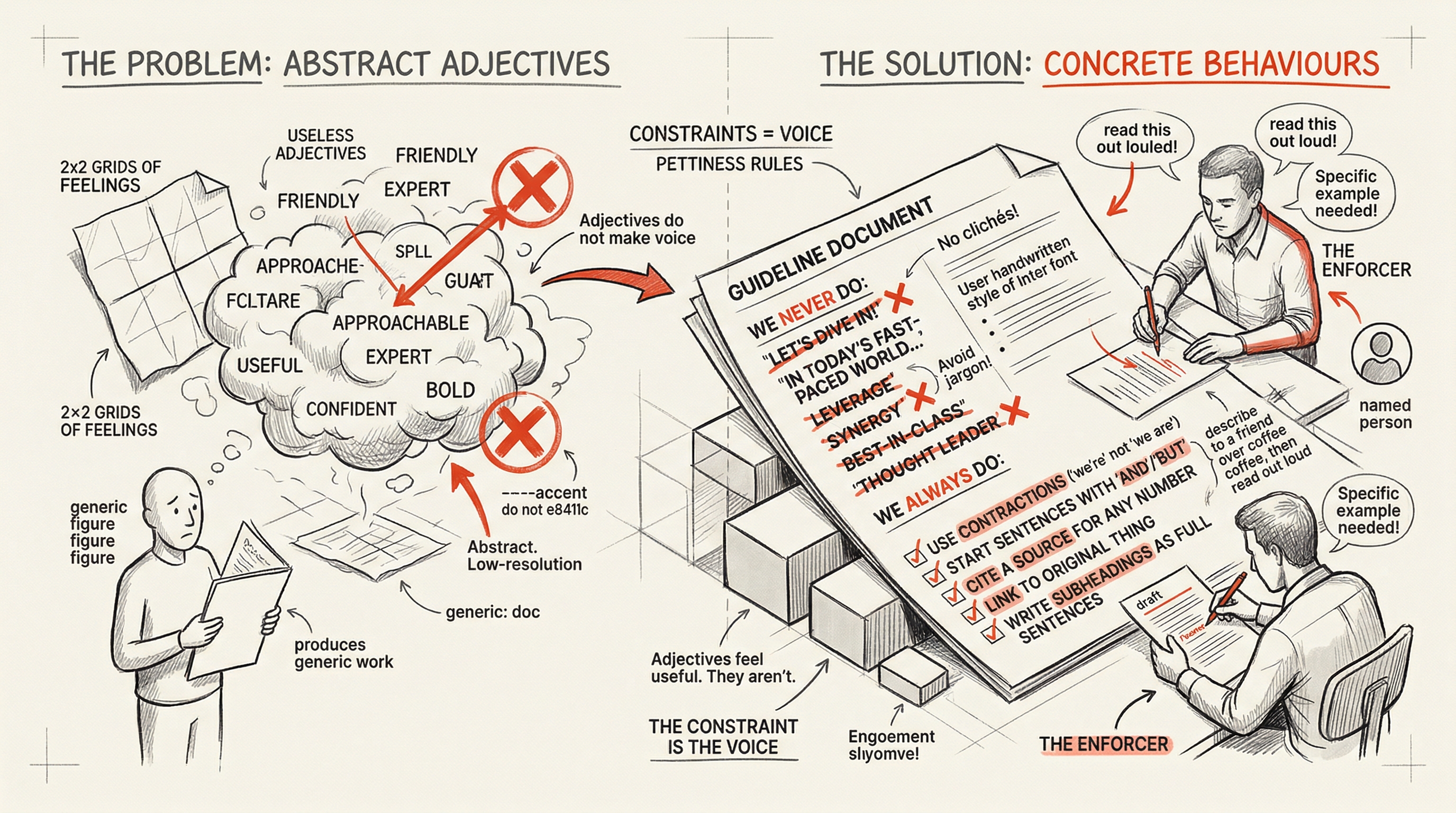
The reason is simple and almost nobody fixes it. A brand voice document, in the form most companies write it, describes adjectives. It says things like “friendly,” “confident,” “approachable,” “expert but not condescending.” It puts those adjectives in a 2x2 grid. It includes a “we are / we are not” table where one column says “warm” and the other column says “stiff.” Then it gets uploaded to a Notion page, the writers nod, and three months later every blog post still sounds exactly like it did before.
Adjectives don’t make voice. Behaviours do.
What “friendly” actually means in the doc you wrote
Imagine I’ve just been hired as a freelance writer for your brand and you hand me your brand voice doc. The first page says: “Our voice is friendly, expert, and approachable.” I now have to write a 1,200-word blog post.
Here’s the problem: every writer in the world has a different idea of what “friendly” means in writing. For some writers it means starting sentences with “And.” For others it means using contractions. For others it means dropping in a joke. For others it means signing the post with “xo.” All of these are “friendly.” None of them are the same voice.
I will, on average, default to whatever I think “friendly” means based on the last brand I worked for. Which means your brand voice is now roughly the average of every brand I’ve ever worked for. Which means it’s not really a voice at all.
The doc didn’t fail because the adjectives were wrong. It failed because adjectives are too low-resolution to do the job.
What “behaviour” looks like instead
A brand voice doc that actually works tells writers what to do, not what to be. The difference is concrete vs. abstract. Compare these two ways of saying the same thing:
Adjective version: “Our voice is conversational and direct.”
Behaviour version:
- We use contractions. (“we’re” not “we are.”)
- We start sentences with “And” and “But” when it improves the rhythm.
- We never use the phrase “in this article we will discuss.”
- We never use the phrase “let’s dive in.”
- We use “you” more often than “users.”
- When we make a claim, we follow it with a specific example or a number. Not optional.
- We don’t end posts with a CTA to “book a demo.” We end them with a takeaway.
The behaviour version is tedious to write and it works. If you give it to two writers, both writers will produce work that sounds reasonably similar. That is the entire job of a brand voice document. If two writers can’t produce similar work after reading it, the document has failed.
The two questions a good voice doc answers
Every useful brand voice document I’ve seen answers exactly two questions, and most of them answer them in plain language without a 2x2 grid in sight.
What do we always do?
A list of behaviours that are always present in writing for the brand. Specific rules with specific examples. The rules should be tight enough that breaking them is obvious. Examples:
- We always use the active voice.
- We always cite a source for any number we publish.
- We always link to the original thing we’re writing about, not a middleman.
- We always write the headline last, after the post is finished.
- We always write subheadings as full sentences, not noun phrases. (“How email open rates have changed,” not “Email open rates.”)
Each of these is a real rule. Each of them is enforceable in editing. None of them are adjectives.
What do we never do?
A list of moves the brand doesn’t make. This is usually the more useful list, because it’s easier to teach a writer what to avoid than what to invent. Examples:
- We never start a post with “in today’s fast-paced world” or any variant.
- We never use the phrases “leverage,” “synergy,” “best-in-class,” “thought leader.”
- We never write headlines in title case. (Sentence case only.)
- We never put a popup over the content of an article.
- We never end a sentence with “and more!”
- We never use the phrase “let’s dive in.” Ever.
If you write down twenty things you never do and your writers stop doing them, you have made the voice more consistent than 80% of the brand voice documents I have read.
A brand voice document is a list of constraints, not a list of feelings. The constraint is the voice.
The example pair
Here’s what a bad voice doc and a good one look like, paraphrased from real ones I’ve worked with. Both anonymised.
The bad one (typical SaaS startup)
Our voice is:
- Friendly but not unprofessional
- Expert but not arrogant
- Confident but not pushy
- Approachable but not sloppy
We are / we are not:
We are We are not Warm Cold Conversational Stiff Bold Reckless Helpful Salesy
This is a typical brand voice doc and it tells you nothing actionable. Two writers will produce wildly different work after reading it.
The good one (a real ecommerce brand I worked with — anonymised)
Always:
- Write headlines in sentence case.
- Use contractions.
- Write product descriptions in first person plural (“we” — the team, not the brand voice trick).
- Cite the source on any health or science claim. No exceptions.
- Address the reader as “you,” not “our customers.”
- When describing how a product works, describe it the way you’d describe it to a friend over coffee. Then read it out loud. If you wouldn’t say it, rewrite it.
Never:
- Start a sentence with “We’re so excited to…”
- Use the words “innovative,” “premium,” “luxurious,” or “curated.”
- Write a subject line that ends in an emoji.
- Use exclamation marks except in headlines, where they are allowed twice per quarter.
- Write a 600-word product description when 200 will do.
- End a marketing email with “stay safe!”
The five-second rule: Before you publish anything, read the first sentence out loud. If it sounds like a press release, rewrite it.
The second one is tedious. It’s also clearly written by someone who knew what they wanted, has thought about it specifically, and cares enough to enforce it. Two writers given that document will produce work that sounds more alike than two writers given the first one.
The thing nobody puts in the doc
The most important thing a brand voice document can include is a single named person who has the authority to enforce it. Not a committee. Not a “brand team.” One person, named, whose job includes “say no to copy that doesn’t sound like us.”
Without that person, the document is wallpaper. Writers read it, nod, and write whatever they were going to write anyway. The enforcer is what makes the document do work.
The good ecommerce brand voice doc above worked because there was a content director who pushed back on copy that broke the rules, every single time, with the document open in front of her. Three months in, the writers had internalised the rules and the pushback stopped happening. That’s when the voice became real.
How to fix yours this week
You don’t need to throw out your existing document. You need to add three things to it:
- A “never” list. Twenty specific things the brand never does. Be petty. The pettier the rules, the easier they are to enforce.
- A “behaviour” list. Replace each adjective with a specific writing rule. Don’t say “conversational” — say “use contractions, start sentences with And and But, avoid the passive voice.”
- A named enforcer. One person whose job is to push back on copy that breaks the rules. Tell the writers their name.
If you do those three things, your brand voice document will start doing work it was never doing before. Your blog will start sounding like your blog. Your emails will start sounding like your emails. And six months from now, somebody on the team will rewrite a paragraph because “that doesn’t sound like us” — and they’ll be right, because they’ll know what “us” actually means.
For what it’s worth: this site runs on roughly the rules I’m describing here. The closest thing I have to a stated always/never list is the about page, but every piece on the site has been edited against the same set of constraints. If an article ever stops sounding like the rest, it’s because I broke one of my own rules and an editor I respect should call me on it.
If you want a related piece on something else that’s “obvious wisdom but mostly wrong,” stop A/B testing your button colours is in the same key. Or, for a longer breakdown on what actually consistent voice looks like in practice, I reverse-engineered how 10 SaaS companies do content marketing ends up being mostly about voice in disguise.
Adjectives feel useful. They aren’t. The voice is in the constraints.